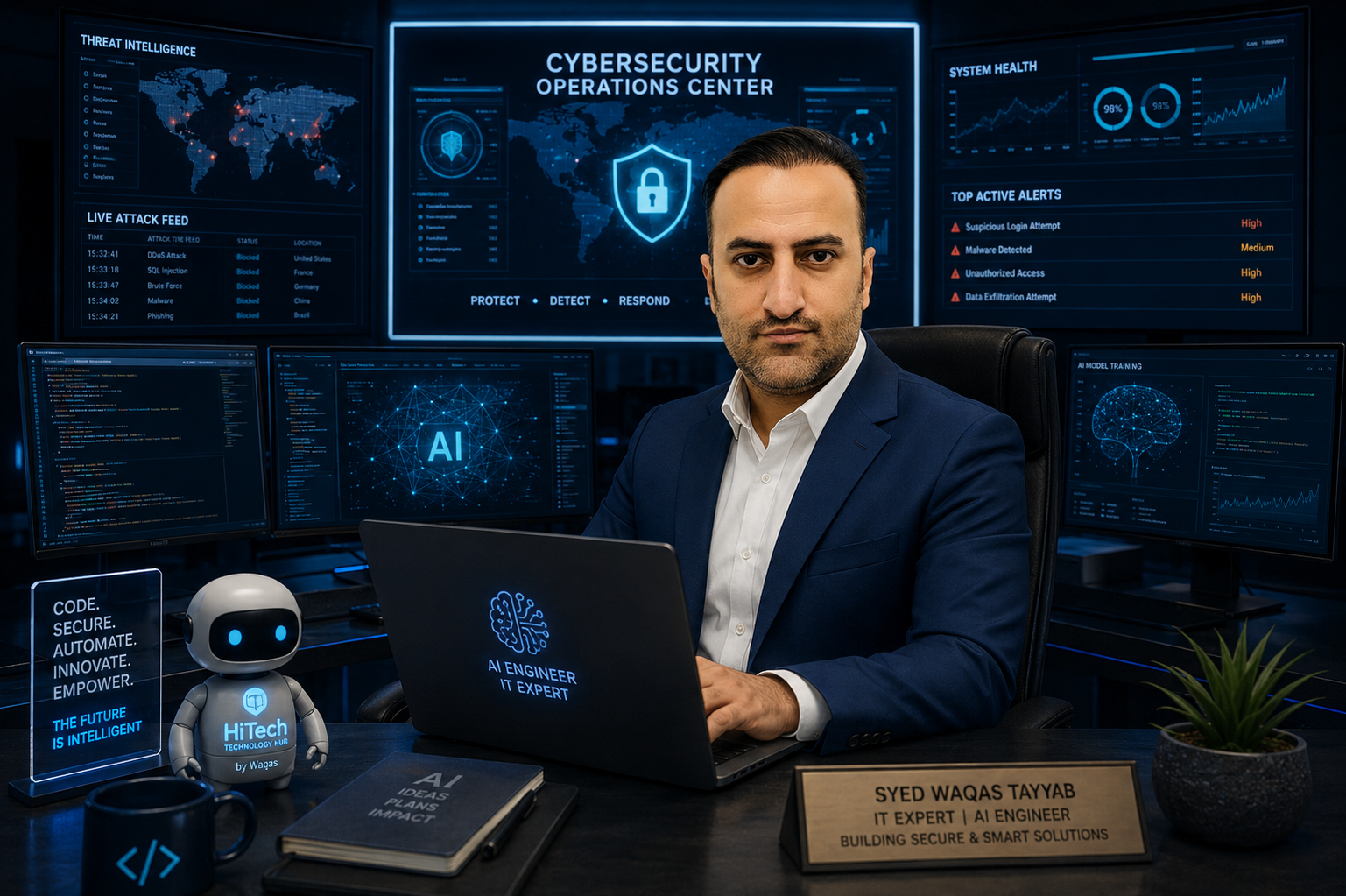
From IT Admin to AI Engineer: The Self-Taught Roadmap That's Actually Working
My background is in IT infrastructure and systems engineering, where I spent 14 years managing enterprise systems at SAP across three offices in Saudi Arabia. Azure Security certified. ITIL v3. PMP-trained. MBA. Everything an IT career progression is supposed to look like.
Then AI happened — properly — and I decided I wasn't going to watch it from the outside.
This is the roadmap I'm on. Not a theoretical framework. The actual projects I've built, the skills I've gained, and where this is heading.
Syed Waqas Tayyab
Senior IT System Engineer · SAP Saudi Arabia · 15+ Years
Azure Security Certified · SAP AI Hub · MBA · MENA IT Expert
Why IT Infrastructure Engineers Have an Unfair Advantage in AI
Before I describe the learning path, I want to explain something that most career transition guides miss.
Infrastructure engineers understand production systems. We know what happens when a daemon crashes at 3 AM. We know that "it works on my machine" is not a deployment. We know the difference between a demo and a system that runs for 18 months without intervention.
ML engineers who came up through academic pipelines often struggle with productionisation. They can train a model. They struggle to serve it reliably, monitor it, handle failure gracefully, and integrate it with enterprise systems.
IT infrastructure engineers struggle in the opposite direction — the model-building side. But the production engineering side? We live there.
That asymmetry is the advantage. Build toward it.
Phase 1: Python Fundamentals Through a Real Project
The worst way to learn Python is tutorials. You watch, you copy, you forget.
The best way is a project with a problem you actually care about solving.
My first project: a password generator desktop app.
Not because password generation is complex. Because it forced me to learn:
- Variables, loops, conditions, functions — all in a real context
- Event-driven programming (GUI responds to button clicks)
- The difference between a script and an application
- File I/O and local database persistence
- Packaging: turning a
.pyfile into a double-click.appthat anyone can use
By the time I finished, I had Tkinter, SQLite3, and PyInstaller working together. More importantly, I had built something that ran without me — a closed system with its own data persistence and UI.
What this phase teaches: Python syntax is not the hard part. Application structure is. Learning to design a program that has state, responds to events, and persists data is the foundation of every ML pipeline you'll ever build.
Phase 2: Data Engineering Through a Corporate Problem
My second project: the IT Asset Manager.
The problem was real. 580+ enterprise assets tracked in a shared Excel file that no one trusted. Duplicate serial numbers. No audit trail. No dashboard. I knew the problem intimately because I lived it every day.
The solution required:
| Skill Required | Where It Appears in ML Engineering |
|---|---|
| Flask web framework | FastAPI for model serving |
| SQLite schema design | Data pipeline schema design |
| Pandas for Excel processing | Pandas for training data processing |
| OpenPyXL for Excel export | Data export and reporting |
| Chart.js dashboards | ML metrics dashboards |
| REST API design | Model serving endpoints |
| Data validation | Training data quality checks |
| Audit logging | Experiment tracking |
Every skill I developed building this web app maps directly to ML engineering work. The tools are different. The thinking is identical.
What this phase teaches: Data engineering is the unsexy core of ML. Building a real data pipeline with validation, transformation, import/export, and reporting is the same mental model as an ML data pipeline — just with different data types.
Phase 3: API Integration and Production Systems
The jump from local applications to production systems that talk to the outside world.
Projects in this phase:
- SAP O365 MCP Server: OAuth 2.0, Microsoft Graph API, token refresh flows, Azure AD Conditional Access workarounds
- ServiceNow WhatsApp Alerter: REST API polling, Twilio API, background daemons, cron scheduling, error handling at 3 AM
- Waqas AI Hub: FastAPI async backend, 15+ REST endpoints, native macOS Swift wrapper, 9 integrated external APIs
The skills this phase required: async programming, OAuth 2.0 authentication flows, retry logic, structured logging, background process management, API rate limiting, token expiry handling.
These are identical to the skills required to build a production ML inference API. The model is just another component in the same pattern: receive request → validate → process → respond → log.
What this phase teaches: Production engineering is about reliability, not cleverness. Error handling, logging, graceful degradation — the same principles apply whether you're serving user queries or ML predictions.
Phase 4: AI Integration and Agent Development
This is where the infrastructure background pays compound interest.
Model Context Protocol (MCP): I built MCP servers that give Claude AI direct access to enterprise tools — SAP Outlook, Calendar, OneDrive, SharePoint, ServiceNow. Natural language control of enterprise systems. This required understanding both the AI layer (Claude API, tool use, context management) and the enterprise layer (OAuth, Graph API, cookie auth).
AI Chat Widget in the Asset Manager: The widget accepts natural language queries, sends them to Claude with the database schema as context, receives a generated SQL query, executes it safely, and formats the results. A complete AI-integrated enterprise application.
Email Summarisation Agent: Every morning at 9 AM, a Python agent reads the SAP inbox, passes the emails to Claude with a structured prompt, receives a prioritised action list in JSON, and displays it as dashboard cards. End-to-end AI automation.
What this phase teaches: AI is a component, not a magic box. Understanding how to integrate it as a reliable component in a production system — with fallbacks, timeouts, structured outputs, and error handling — is what separates an AI engineer from an AI user.
The Certification Stack
Certifications matter for credibility, not knowledge. Get them in the right order.
Current stack:
- Microsoft Azure Security Engineer Associate (2024) — the hardest to get, the most valued for enterprise
- SAP Certified: Generative AI Hub (AIG02) (2026) — SAP's entry-level AI certification
- SAP Python ML for SAP HANA (2026) — Python ML fundamentals in the SAP context
- SAP Analytics Cloud (2023) — data and BI layer
- SAP S/4HANA Administration (2022) — enterprise system fundamentals
- ITIL v3 Foundation (2017) — ITSM thinking that applies directly to MLOps
- PMP Training — 35 PDUs (2018) — project management for complex technical deployments
Planned:
- SAP Certified: Business AI (C_BCBAI) — comprehensive business AI certification
- SAP Certified: Generative AI (C_AIG) — advanced generative AI engineering
The pattern: build toward AI/ML certifications while maintaining the enterprise IT credibility that makes the transition credible to hiring managers. A CV that only shows AI projects from the last 12 months looks junior. A CV that shows 14 years of enterprise IT work, recently pivoting toward AI, looks like a senior professional with a specialisation — which is exactly what it is.
What's Actually Hard About This Transition
Mathematics. Linear algebra, calculus, statistics — the mathematical foundations of ML are real prerequisites for going beyond API calls into actual model development. I'm building these skills systematically. The Khan Academy and 3Blue1Brown approach works for someone who hasn't touched maths since university.
Unlearning the "operational" mindset. IT engineering is about stability and predictability. ML engineering is about experimentation and iteration. Models fail. Experiments are wrong. This is the process, not a problem to be solved. Adjusting to this took time.
The imposter syndrome of building on existing models. Using Claude API or Hugging Face isn't "real AI work" — that's the feeling. It's wrong. The majority of production AI engineering is exactly this: integrating, fine-tuning, and orchestrating existing models for specific enterprise use cases. That's where the value is created.
The Evidence That It's Working
I'm not pitching a future state. I'm describing present reality.
I have, deployed and running in production:
- 4 AI automation tools running daily for enterprise IT operations
- 1 MCP server giving AI direct access to Microsoft 365
- 1 AI chat widget inside a corporate web application
- 1 email summarisation agent processing a corporate inbox every morning
- 37 documented projects, 8 of which involve direct AI/ML integration
The SAP Generative AI Hub certification passed. The Python ML for SAP HANA certification passed. The code works. The tools save hours daily.
The transition isn't theoretical. It's happening.
The One Piece of Advice That Made the Difference
Build something real before you finish learning.
Every productive learning session I've had started with a problem and ended with something running. Every unproductive learning session started with a tutorial and ended with a closed browser tab.
You don't learn Python by reading about Python. You learn it by building the thing until it works, then asking why it works.
The AI tools available now — Claude Code, Copilot, ChatGPT — dramatically compress the learning loop. I'm not suggesting you use AI to avoid learning. I'm suggesting you use it to debug faster, understand error messages more quickly, and spend your mental energy on design decisions rather than syntax lookup.
That's not cheating. That's how senior engineers work.
Waqas Syed is a Senior IT System Engineer and AI Automation engineer at SAP Saudi Arabia. He documents his AI/ML transition at HiTecH Technology HUB and is actively building toward ML Engineering roles in the MENA region.