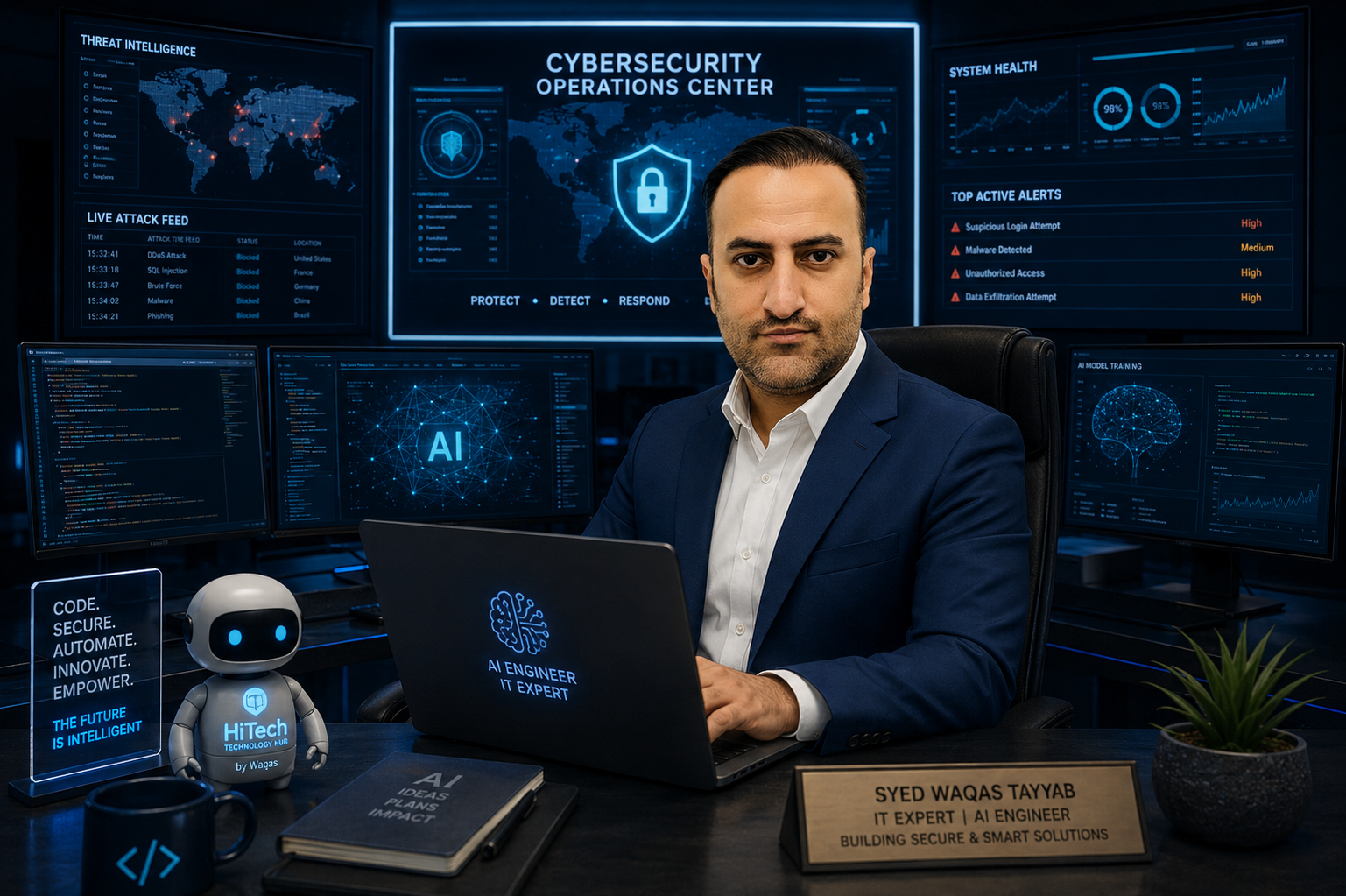
My Top 10 Strategic Technology Trends for 2026 — Why Every IT Leader Must Act Now
Every year, a wave of technology trend reports lands in executive inboxes. Executives forward them in meetings. Engineers go back to their terminals. The gap between the boardroom and the machine room is where transformation quietly dies.
I have spent 15 years on both sides of that gap — managing infrastructure, deploying enterprise systems across MENA, automating IT operations, and building AI tools from scratch on my own time. These ten trends are not a curated list from a research firm. They are the priorities I have arrived at through hands-on work, validated against what leading research is also converging on. Here is what each one actually means for the people who have to build it, run it, and keep it secure.

Syed Waqas Tayyab
Senior IT System Engineer · SAP Saudi Arabia · 15+ Years
Azure Security Certified · SAP AI Hub · MBA · MENA IT Expert
The Three Themes I Organise These Around
After analysing where enterprise IT is heading in 2026, I group these ten priorities into three strategic layers — infrastructure at the bottom, application logic in the middle, governance at the top. You cannot skip a layer.
- The Architect — build the foundation: AI platforms and the infrastructure that runs them
- The Synthesist — orchestrate the value: AI applications, agents, and physical-digital systems
- The Vanguard — protect what you build: cybersecurity, trust, and geopolitical risk
Each theme is a mandate, not a menu. Organisations that cherry-pick one layer while ignoring the others will find themselves with powerful tools they cannot trust, or airtight governance over systems that cannot scale.
Theme 1 — The Architect: Build the AI Foundation Right
1. AI-Native Development Platforms
The promise here is real and the risk is equally real. AI-native development platforms allow small engineering teams to build and ship software at a speed that was previously impossible without a large workforce. In practice, I have seen this firsthand: a single engineer with Claude Code, GitHub Copilot, and a well-structured codebase can deliver features in days that previously took a sprint.
What this means operationally: Your software governance model needs to catch up. Code review, security scanning, and deployment pipelines designed for human-written code will not automatically flag AI-generated vulnerabilities — SQL injections, exposed secrets, logic errors in generated boilerplate. The automation is only as good as the guardrails you put around it.
The implementation priority: Before scaling AI-native development, invest in automated security scanning (SAST/DAST) and enforce it at the pipeline level, not as a post-release audit.
2. AI Supercomputing Platforms
Training large models and running advanced analytics at enterprise scale requires compute infrastructure that most organisations do not own and cannot justify owning. Cloud-native AI supercomputing — Azure AI, AWS SageMaker, Google Vertex — is the practical path.
The real constraint is not compute — it is cost governance. A model training run without budget controls can consume a month's cloud budget overnight. I have seen it happen in enterprise proof-of-concept projects where nobody owned the billing alert.
The implementation priority: Establish FinOps practices for AI workloads before you scale. Tag every AI resource, set hard budget alerts, and require cost estimates as part of the AI project intake process.
3. Confidential Computing
This is the least discussed trend on the list and arguably the most important for regulated industries. Confidential computing protects data while it is actively being processed — not just at rest or in transit. This enables secure AI inferencing over sensitive data (medical records, financial data, HR files) without exposing it to the compute infrastructure.
For organisations in Saudi Arabia operating under PDPL (Personal Data Protection Law) and Vision 2030 digital infrastructure commitments, this is not a future consideration — it is a current compliance requirement for AI workloads touching citizen or employee data.
The implementation priority: Map your AI use cases against data sensitivity tiers. Any AI pipeline touching PII, health records, or financial data should be evaluated for confidential computing enclave deployment before going to production.
Theme 2 — The Synthesist: Make AI Deliver Actual Value
4. Multiagent Systems
Single AI models are impressive. Networks of specialised AI agents collaborating on complex tasks are transformative. A multiagent architecture breaks a large problem into sub-tasks and assigns each to a specialised model — one reads documents, one queries a database, one drafts a response, one validates the output.
I built a simplified version of this in my own environment: separate Python scripts that monitor ServiceNow tickets, scan SAP email for SLA signals, and push WhatsApp alerts — all orchestrated by a central scheduler. That is a primitive multiagent system. Enterprise-grade versions are orders of magnitude more capable.
The implementation risk: Agent coordination introduces failure modes that single-model systems do not have. An agent that produces a hallucinated intermediate result can corrupt every downstream agent that depends on it.
The implementation priority: Build explicit validation gates between agents. Never allow an agent's output to flow directly into a consequential action (sending an email, updating a database, executing a transaction) without a human or rule-based verification step.
5. Domain-Specific Language Models
General-purpose LLMs like GPT-4 and Claude are powerful but they are generalists. For legal, medical, financial, or industrial use cases, a smaller model trained on domain-specific data consistently outperforms a larger general model — with lower latency and lower cost.
In the SAP ecosystem, this translates directly: an LLM fine-tuned on SAP S/4HANA documentation, ITSM ticket data, and ABAP code will outperform a general model on every SAP-specific task.
The implementation priority: Identify your top three repetitive AI use cases and evaluate whether a fine-tuned or retrieval-augmented domain model would outperform your current general-purpose model. The ROI calculation almost always favours specialisation at scale.
6. Physical AI
Robots, drones, autonomous vehicles, and smart equipment are no longer research projects. Physical AI is in warehouses, data centres, hospitals, and factory floors today. The IT implication is network and edge infrastructure: these systems require ultra-low latency connectivity, local inference capability, and security architectures designed for physically accessible endpoints.
In the MENA region, Vision 2030 mega-projects — NEOM, Red Sea Project, King Salman Energy Park — are deploying physical AI at a scale that will require thousands of IT engineers who understand how to operate these systems. This is not a five-year horizon. Hiring and capability-building needs to start now.
The implementation priority: Add OT/IoT security and edge computing to your IT team's training roadmap. The convergence of IT and OT is already happening — the question is whether your team is ready to manage it.
Theme 3 — The Vanguard: Security, Trust, and Geopolitical Reality
7. Preemptive Cybersecurity
The security model of "detect and respond" is broken. By the time an alert fires, the breach has occurred, the data has moved, and the damage is done. Preemptive cybersecurity uses AI to identify attack patterns, predict likely vectors, and block threats before they execute.
Microsoft Defender for Endpoint, which I have deployed and managed at enterprise scale, already embeds this logic — behavioural analysis, anomaly detection, and automated isolation of compromised endpoints. The challenge is not the tool; it is configuration depth and alert fatigue management.
The implementation priority: If you are running Defender or a similar XDR platform, audit your detection rules. Most enterprise deployments use default configurations that generate enormous noise. A well-tuned rule set with clear escalation paths is worth more than five additional security tools layered on top of a noisy baseline.
8. Digital Provenance
When AI can generate code, documents, images, audio, and video indistinguishable from human-created content, the question of "where did this come from and has it been altered?" becomes a fundamental trust and compliance issue.
Digital provenance — cryptographic signing, content credentials, and chain-of-custody verification for digital assets — is not yet mainstream enterprise practice. But regulatory pressure is building. The EU AI Act, NCA cybersecurity requirements in Saudi Arabia, and emerging procurement standards are all moving toward mandating provenance for AI-generated content used in official processes.
The implementation priority: Begin cataloguing your AI-generated content workflows now. Identify where AI-generated text, code, or documents enter official records, contracts, or regulatory filings. This is where provenance controls will be mandated first.
9. AI Security Platforms
Every new AI tool your organisation deploys is a potential attack surface — prompt injection, model poisoning, data exfiltration through LLM APIs, and insecure plugin integrations. AI Security Platforms provide centralised visibility and control across the AI application layer.
This is an emerging category and the tooling is not yet mature. But the principle is sound and urgent: you cannot secure what you cannot see. The first step is an AI application inventory — what models are being used, by whom, connected to what data, with what access controls.
The implementation priority: Conduct an AI shadow IT audit. In most enterprises, individual teams have already connected AI tools to corporate data without formal security review. Find them before an attacker does.
10. Geopatriation
Geopolitical risk is now an IT infrastructure decision. Sanctions, data sovereignty laws, and supply chain restrictions mean that where your data sits and who owns the infrastructure running it is a boardroom-level question. Geopatriation — moving workloads to sovereign or regional cloud providers to reduce geopolitical exposure — is the enterprise response.
For organisations in Saudi Arabia, this intersects directly with the Saudi Cloud Computing Regulatory Framework and NCA requirements for data localisation in critical sectors. The question is not whether your data needs to be in-country — for many use cases it already does by law. The question is whether your cloud architecture reflects that reality.
The implementation priority: Audit your cloud footprint against Saudi data residency requirements. Identify workloads currently running outside KSA that involve citizen data, government contracts, or critical infrastructure. Build a geopatriation roadmap before regulators build it for you.
The Integrated Picture
These ten trends are not independent line items. They are a system. AI-native development (Trend 1) creates software that needs domain models (Trend 5) and AI security governance (Trend 9). Multiagent systems (Trend 4) running on supercomputing platforms (Trend 2) need confidential computing (Trend 3) to process sensitive data securely. Physical AI deployments (Trend 6) require preemptive security (Trend 7) and geopatriation decisions (Trend 10). And all of it needs digital provenance (Trend 8) to remain auditable and trustworthy.
The CIOs who act on this as a system — not as a checklist of ten separate projects — are the ones who will build something durable.
A Note on Research and Academic Publication
This article is part of a personal initiative to move beyond practitioner commentary into original research. The goal is to develop these analyses into peer-reviewed papers submitted to recognised international journals and conferences — specifically targeting venues that bridge enterprise IT practice and academic computer science: IEEE Transactions on Engineering Management, Computers & Security, the International Journal of Information Management, and ACM's CSCW.
If you are an academic, researcher, or institution interested in collaborating on empirical research in enterprise AI deployment, IT operations automation, or cybersecurity governance in emerging markets — particularly the MENA region — I welcome the conversation. Practitioner data from real deployments is exactly what most academic AI research lacks.
Contact: waqastayyab2004@gmail.com
Research basis: This analysis draws on 2026 strategic technology research from leading analyst firms, cross-referenced with hands-on enterprise deployment experience across MENA. All implementation guidance and priority assessments are the author's own.
About the Author
Syed Waqas Tayyab is a Senior IT System Engineer at SAP Saudi Arabia with 15+ years of enterprise IT experience across MENA. He specialises in IT operations automation, AI-powered tools, ServiceNow ITSM, and Microsoft security platforms. He is currently pursuing the SAP Certified Generative AI Developer certification and building open-source tools at the intersection of enterprise IT and applied AI.